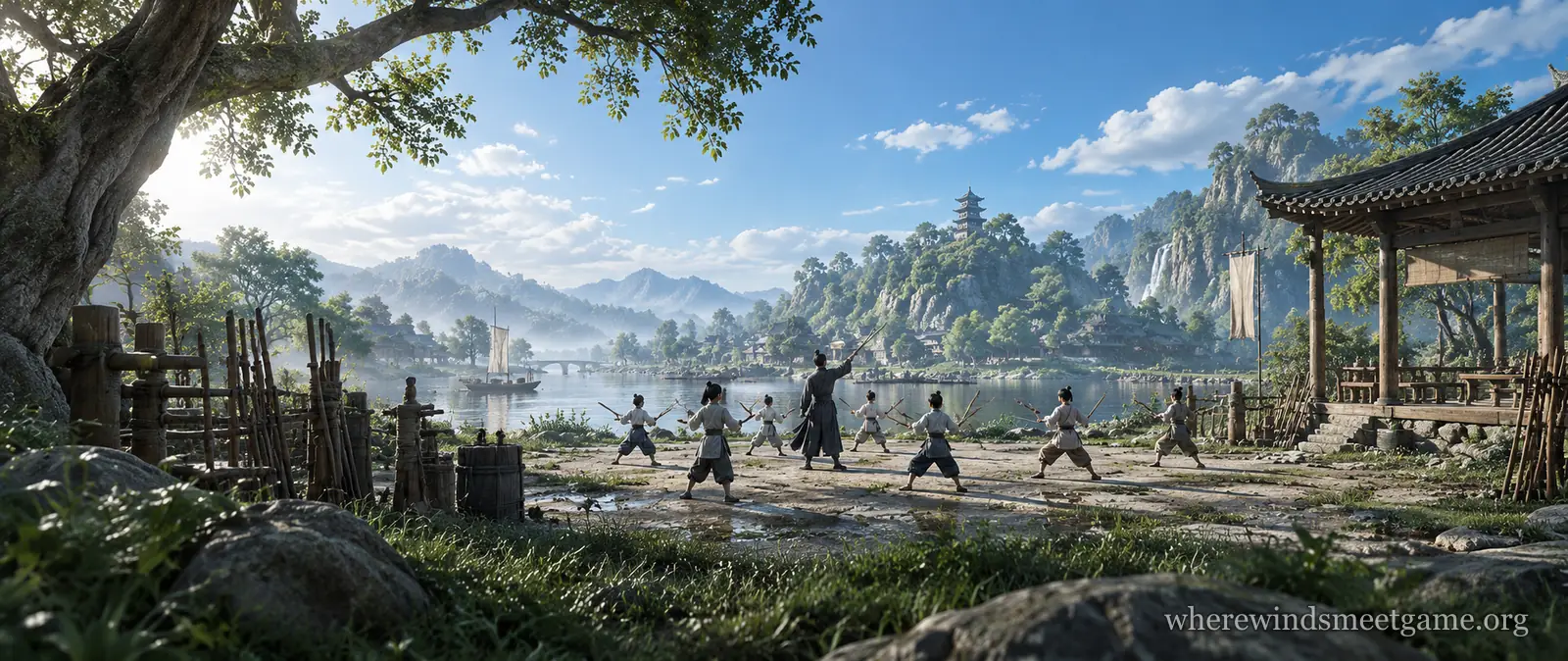
Where Winds Meet is a wuxia open-world action RPG from NetEase where your combat style comes from weapons, not a class choice — there is no class system, and the character creator is purely cosmetic. Your first real decision arrives early, when an NPC lets you pick a weapon that shapes your opening hours: the Nameless Sword is the most forgiving all-rounder, while the Panacea Fan adds self-healing in a game with no passive HP regeneration. Nothing is permanent — every weapon and Martial Art can be unlocked later, and the sects you can join are an optional mid-game system, not a starting commitment. This guide covers the four things that matter most in your first ten hours: choosing that first weapon, understanding RPG mode versus MMO mode, the combat fundamentals (stamina, parry, healing), and — if you're starting in 2026 — how to catch up on this year's updates.
Fully re-checked and corrected on July 8, 2026 — see the note on sects below. The catch-up list was brought up to Version 2.2 on October 11, 2026.
Guide Overview
| Aspect | Details |
|---|---|
| Reading Time | ~6 min read |
| Key Topics | First Weapon Choice, Sects (Corrected), Combat Basics, Starting in 2026 |
| Recommended For | New players (0-10 hours) |
Your First Real Choice: The Starting Weapon
Early in the game — after the prologue introduces you to the basics — you'll meet an NPC who lets you choose a weapon, and this is the decision that actually shapes your opening hours. Two picks stand out for new players:
- Nameless Sword — the most beginner-friendly weapon in the game: fast, fluid, strong single-target damage, and its parry-centered gameplay teaches you the defensive timing every other weapon also relies on. It's the foundation of the most forgiving starter build and stays top-tier all the way into endgame — see our July 2026 tier list.
- Panacea Fan — the healer's pick, and a sneaky-good solo choice: it can heal you as well as allies, which is worth a lot in a game with no passive HP regeneration, and its ranged attacks let you learn boss patterns from a safe distance.
Whichever you pick, don't agonize: every weapon and Martial Art can be obtained later through normal play, several within the first few hours. You can also equip two Martial Arts at once, so your "build" is a pairing, not a single weapon.
💡 Healing Tip: There's no passive HP regen in WWM. Check our HP Recovery Guide to learn all the ways to restore health.
How Sects Actually Work
Correction note: earlier editions of this guide described sect selection as your first major decision, like picking a class. That was wrong, and we've rewritten this section — here is how the system actually works.
You start the game sectless, and you can stay that way. Sects in Where Winds Meet are optional organizations you can join later, not a character-creation choice:
- Sects unlock a few levels into the game (around level 10). Joining means following clues to a Sect Elder in the world and meeting their requirements — sometimes a quest chain, sometimes a trial.
- There are 11 sects, and in Version 2.2 you can join eight: Well of Heaven, Silver Needle, Midnight Blades, Nine Mortal Ways, Velvet Shade, The Masked Troupe, Raging Tides and Mohist Hill. The newest, Mohist Hill, opened with Version 2.0 (July 23, 2026); you can join it from level 10 after completing Haven Astray (official Version 2.0 overview). Hollow Vale, Lone Cloud and Inkbound Order have no way to join yet. Our sects guide covers what each one teaches and how to join it.
- Each sect's entry gift includes its signature Martial Art and a matching weapon, and each has its own rules and weekly expectations (Midnight Blades rewards PvP; Silver Needle expects healing).
- Staying sectless is fully viable — all weapons work without a sect, and you keep more quest freedom because sect rules never restrict you.
- The Skill Theft system lets you learn a sect's private Martial Art without joining it.
- If you do join, you can leave anytime (leaving resets your rank in that sect, with a cooldown before rejoining) and even return to one you previously abandoned.
The practical advice for beginners: ignore sects entirely for your first hours. Explore the system once you know your preferred playstyle — a sect whose signature art complements your weapons is worth more than one picked blind at the start.
Understanding Game Modes
Where Winds Meet offers two distinct gameplay modes on the same character:
- RPG Mode: a single-player-paced experience — story, exploration, and combat without other players in your world.
- MMO Mode: multiplayer interactions and content — co-op bosses, PvP, and guild systems like faction wars.
Start in RPG mode. The game front-loads a lot of systems (Martial Arts, Mental Methods, stamina, parry timing), and learning them at your own pace beats learning them while other players blur past you. Your progress carries over, so switch to MMO mode whenever the multiplayer content starts calling.
Combat Basics
The Three Pillars of Combat
- Light Attacks: fast, low-damage strikes that build your combos
- Heavy Attacks: slower, high-damage moves, often chargeable
- Martial Art Skills: special abilities tied to your weapons — not to any sect or class
Stamina Management
Your stamina bar powers both offense and defense — attacking, dodging, and parrying all draw from it. The one rule that matters: never let it fully deplete mid-fight, because a drained bar means you can neither finish your combo nor dodge the counterattack that follows. Watch your bar during boss fights, weave pauses between combo strings, and remember that defensive actions need a reserve. Deeper combat mechanics — deflect timing, weapon-swap pressure, and starter-friendly setups — are covered in our Combat Guide for Beginners.
Progression Systems Overview
Character Levels
- Main story quests provide the most experience — follow them as your spine
- Side quests offer valuable resources and unlock features; don't skip them wholesale
- Daily activities keep progression steady once you're established
Equipment and Gear
Early on, story rewards are enough — resist the urge to optimize gear in your first hours. The systems that actually move your power early are Mental Methods (start with our beginner's guide to Mental Methods and the Qinghe route) and weapon skill unlocks. Gear optimization becomes worth your attention once story rewards stop keeping pace.
Starting in 2026? Here's Your Catch-Up
If you start now, you begin in Version 2.2 with every 2026 update already in the game; players from the November 2025 launch got them one by one. The additions that matter most early on:
- The Hexi expansion (Versions 1.4 to 1.6, March to April 2026) — three major maps and nearly 20 sub-regions of post-story exploration
- Two new martial paths in spring: Bamboocut - Dust (Version 1.4) and Stonesplit - Strength (Version 1.5)
- Idle Wind (Version 1.6) — a traversal Mystic Skill that makes crossing the open world dramatically faster; pick it up early
- The Homestead estate system (Version 1.8, June 2026) — your own village to rebuild and staff; see our Homestead Guide
- Pet companions (Version 1.8) — cats and geese that react to the weather and the world around them
- The Gauntlets and the Bamboocut - Kite path (Version 2.0, July 23, 2026), along with the Hidden Mountain region and the Mohist Hill sect
- The Bamboocut - Draught path (Version 2.1, September 3, 2026); every path's tier list placings are on our Builds page
- Transdust Ruins (Version 2.2, September 23, 2026) — an extraction mode made with Escape from Tarkov; see our PvP guide for beginners
- Coming next: Qingzhou (Version 2.3, October 15, 2026) — a new coastal region; see our Qingzhou page
Two free wins before you start: try the redeem codes on our codes page (free Echo Jade and other rewards; the page shows which codes other lists still call working), and skim the 2026 Update Timeline so you know what's new versus what's launch content.
Essential Tips
- Complete the Tutorial: Don't skip it! It teaches crucial mechanics
- Unlock Fast Travel Early: Makes exploration much easier
- Save Your Currency: Don't spend premium currency (Echo Jade) on early-game items
- Join a Guild: Guild benefits are valuable even if you mostly play solo
- Experiment with Builds: You can equip two Martial Arts — try combinations before committing investment
Common Mistakes to Avoid
- Ignoring defensive stats in favor of pure damage
- Skipping side quests that unlock important features
- Not using the dodge/parry mechanics — the game is built around them
- Selling quest items before checking requirements
- Stressing over the starting weapon — access is never locked, only investment takes time
- Joining the first sect you meet just because it asked
Next Steps
Once you've mastered these basics, check out our specialized guides:
- Combat Guide for Beginners — how weapons, Martial Arts, and starter builds fit together
- First 3 Hours Guide — what to do first, in order
- Is Where Winds Meet Worth It? — price, Steam reviews, what you get and PC requirements
- Build Tier List — where every build stands right now